
Your mum probably told you eggs were bad for your heart. Your gym buddy probably tells you to eat four a day. And the internet? The internet says both, sometimes in the same article. So you’re standing in front of the fridge at 7 a.m., holding an egg, genuinely unsure if cracking it open is a good idea. Let’s sort this out properly.
The Short Answer: How Many Eggs Per Day Is Safe?
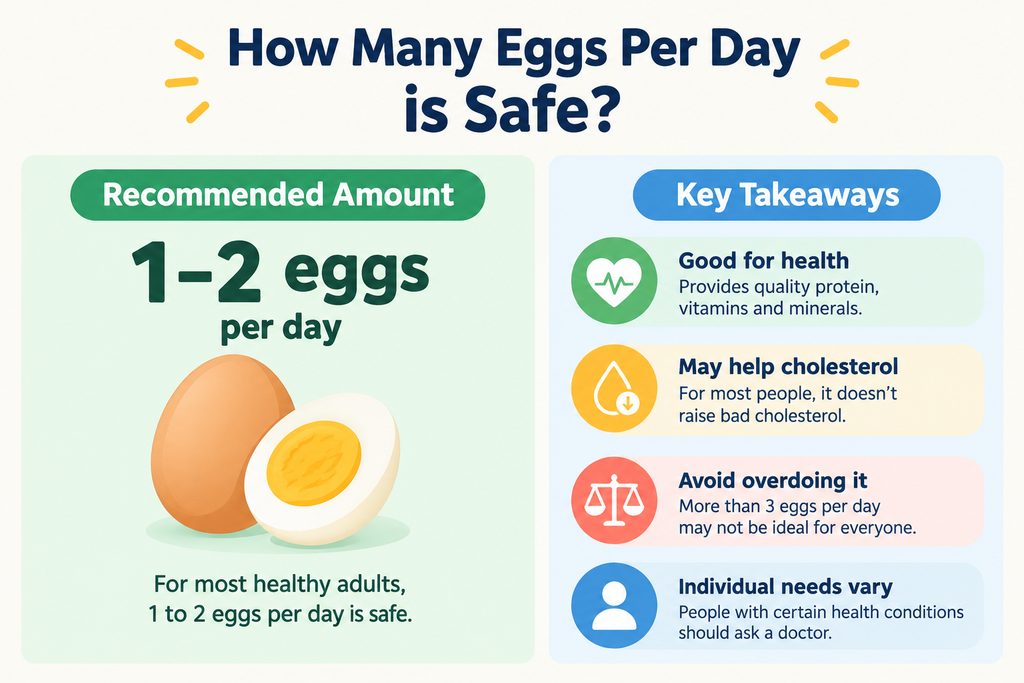
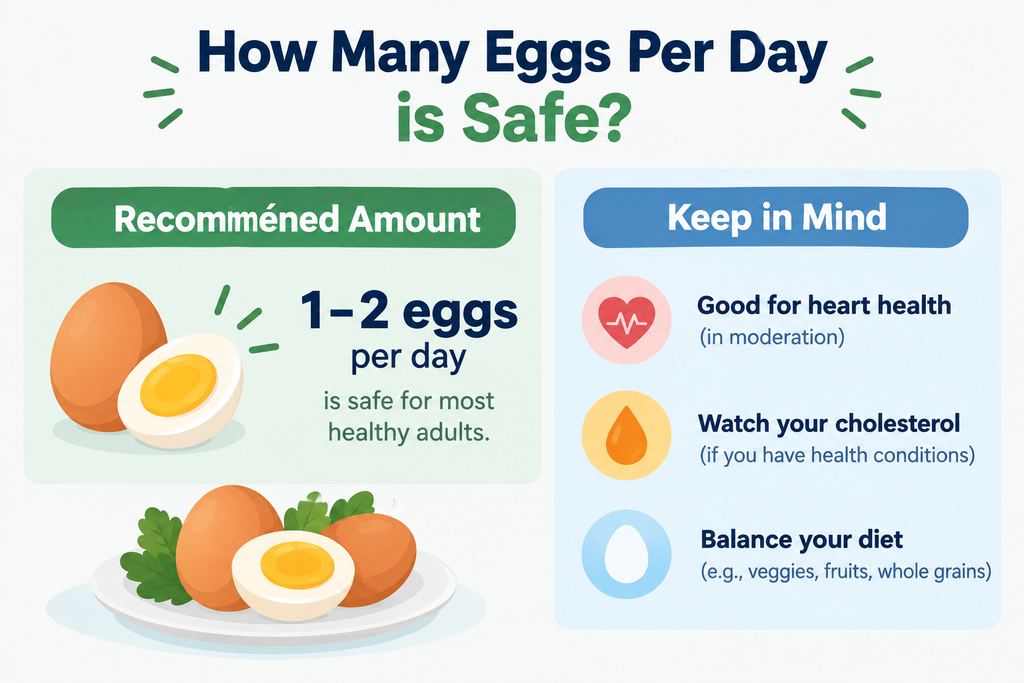
For most healthy adults, eating 1 to 2 whole eggs a day is perfectly safe and fits well within a balanced diet. That’s the number most major health organisations — including the American Heart Association and the UK’s NHS — are comfortable with based on current evidence.
But “most healthy adults” is doing a lot of heavy lifting in that sentence. The real answer shifts depending on your age, your health conditions, and what the rest of your plate looks like. Someone with type 2 diabetes and someone who runs 10K every morning don’t need the same advice, and anyone telling you there’s one magic number for everyone is oversimplifying things.
Medical disclaimer: This article provides general nutrition information based on published research. It is not a substitute for personalised medical advice. If you have high cholesterol, heart disease, diabetes, or any other health condition, speak with your doctor or a registered dietitian before making significant changes to your diet.
Why Eggs Got a Bad Reputation (and Why That Changed)
For decades, eggs were public enemy number one in the nutrition world. The logic seemed airtight: eggs contain cholesterol, high blood cholesterol causes heart disease, so eating eggs must cause heart disease. Simple, right?
Except the human body doesn’t work like a simple plumbing system.
Dietary Cholesterol vs. Blood Cholesterol
Here’s the part most people get tangled up in. The cholesterol in food (dietary cholesterol) and the cholesterol floating around in your bloodstream (blood cholesterol) are related, but they’re not the same thing. Your liver actually produces most of the cholesterol in your body — roughly 80% of it. When you eat more cholesterol from food, your liver typically dials back its own production to compensate.
A large egg contains about 186 milligrams of cholesterol, all of it sitting in the yolk. That sounds like a lot, especially if you grew up hearing the old “300 milligrams per day” limit. But the US Dietary Guidelines quietly dropped that specific cap back in 2015 because the evidence just didn’t support it anymore. The current 2020–2025 guidelines simply recommend keeping dietary cholesterol “as low as possible” without naming a hard number.
What actually moves the needle on your blood cholesterol levels is saturated fat and trans fat, not dietary cholesterol itself. And eggs are relatively low in saturated fat — about 1.6 grams per large egg. You’d get more saturated fat from a couple of rashers of bacon or a generous pat of butter, which is worth thinking about the next time you blame the egg instead of the full fry-up it’s swimming in.
If you want a deeper look at how eggs interact with your cholesterol numbers, this piece on whether eggs raise cholesterol breaks down the mechanism in more detail.
How Many Eggs Per Day Is Safe for Different People
This is where the “it depends” part gets specific. Let’s walk through the most common scenarios so you can find the one that actually applies to you.
Healthy Adults
If you don’t have diabetes, heart disease, or significantly elevated cholesterol, the research is reassuring. A large 2020 study published in the BMJ, which followed over 200,000 men and women for up to 32 years, found that eating up to one egg per day was not associated with a higher risk of cardiovascular disease. Other studies have pushed that number to two eggs daily without showing harm in healthy populations.
So for you, 1–2 whole eggs a day is a reasonable, evidence-backed target. You could eat them every morning and likely be fine, as long as the rest of your diet isn’t loaded with processed meats and deep-fried foods. If you’re curious about making eggs a daily habit long-term, this guide on eating eggs every day covers what to watch for over the months and years.
People with High Cholesterol or Heart Disease
This is where you need to be a bit more cautious. The American Heart Association’s 2019 science advisory suggests that people with existing high cholesterol or heart disease should limit themselves to about 3 to 4 whole eggs per week, which works out to roughly half an egg a day on average. The NHS takes a slightly more relaxed stance, noting there’s no specific recommended limit on egg consumption, but advises people with familial hypercholesterolaemia to be more careful. (Verify the current NHS guidance at nhs.uk/live-well/eat-well for the most up-to-date position.)
The reason isn’t that eggs are suddenly dangerous for you. It’s that your body’s cholesterol regulation may already be struggling, so adding more dietary cholesterol on top of a system that’s out of balance isn’t ideal. That said, the bigger wins will come from reducing saturated fat across your entire diet. Cutting back on fatty red meat, full-fat dairy, and ultra-processed foods will move the needle far more than obsessing over your morning omelette.
If you’ve been told to watch your cholesterol, it’s worth reading about foods to avoid with high cholesterol so you can see the full picture rather than just focusing on eggs in isolation.
People with Diabetes
The evidence here is genuinely mixed, and I want to be upfront about that rather than pretending there’s a clean answer. Some studies, particularly those conducted in the US, have found that people with type 2 diabetes who eat more than one egg a day may have a higher risk of heart disease. Other research, including a well-known Australian trial called the DIABEGG study published in the American Journal of Clinical Nutrition, found no adverse effects on cardiovascular risk markers when diabetic participants ate up to 12 eggs per week compared to fewer than two.
Why the contradiction? It likely comes down to what else people are eating alongside their eggs, their overall dietary pattern, and genetic differences in how individuals process cholesterol.
The safest approach if you have diabetes is to stick to around 4 to 6 whole eggs per week and talk to your doctor or dietitian about what makes sense for your specific numbers. Don’t make this decision based on a single blog post — your blood work tells a more honest story than any headline.
Older Adults and Active Individuals
Older adults actually benefit from eating eggs more than most people realise. Eggs are one of the most nutrient-dense foods you can find — packed with high-quality protein, vitamin D, vitamin B12, choline, and lutein. For someone over 65 who’s struggling to eat enough protein to maintain muscle mass, an egg or two a day can be genuinely helpful. The choline in eggs also supports cognitive function, which becomes increasingly important as we age.
Similarly, if you’re physically active and training regularly, your protein needs are higher, and eggs are a convenient, affordable way to meet them. Two or even three eggs a day is unlikely to be a problem for an active person with no underlying health conditions, especially if you’re eating them as part of a diet rich in vegetables, whole grains, and healthy fats. For more ideas on fitting eggs into an active lifestyle, check out these best sources of protein to round out your meals.
What the Research Actually Says
Let’s zoom out and look at the bigger picture, because individual studies can be misleading if you cherry-pick them.
The most comprehensive meta-analyses — studies that pool data from dozens of smaller studies — generally land in the same place. Moderate egg consumption, defined as up to one egg per day, does not significantly increase the risk of heart disease or stroke in the general population. The Harvard T.H. Chan School of Public Health, which has tracked diet and health outcomes across hundreds of thousands of people for over 30 years, echoes this position on their Nutrition Source page about eggs.
Where things get murkier is at the higher end. Studies looking at three or more eggs per day are fewer, smaller, and less consistent. Some show no harm; others suggest a slight uptick in risk, particularly for people who already have metabolic issues. The honest truth is that we don’t have rock-solid long-term data on very high egg consumption, so if you’re eating four or five eggs a day, you’re operating in a zone where the science can’t give you a confident thumbs-up or thumbs-down.
One thing researchers consistently point out is that the company eggs keep matters more than the eggs themselves. An egg boiled and served with spinach and whole-grain toast is a very different health proposition from an egg fried in butter alongside two sausages and white bread. The overall dietary pattern is what shapes your health outcomes, not a single food in isolation.
Whole Eggs vs. Egg Whites — Does It Matter?
If you’re worried about cholesterol but don’t want to give up your morning eggs, egg whites seem like an obvious compromise. And for certain people, they are.
The yolk contains all of the egg’s cholesterol and most of its fat, but it also holds almost all of the vitamins, minerals, and beneficial compounds. The choline that supports brain health? Mostly in the yolk. The lutein that protects your eyes? Yolk. The vitamin D? Yolk. Stripping the yolk out turns an incredibly nutrient-dense food into a fairly plain source of protein.
For a healthy person eating 1–2 eggs a day, there’s no compelling reason to ditch the yolk. You’d be throwing away the best part of the egg to solve a problem you don’t have.
For someone with familial hypercholesterolaemia or someone whose doctor has specifically asked them to limit dietary cholesterol, using a mix of whole eggs and egg whites can be a smart middle ground. You might use one whole egg plus two egg whites in an omelette, getting the flavour and nutrients from the yolk while keeping the total cholesterol lower. It’s a small tweak, but it can make a real difference if your numbers are borderline.
Practical Tips for Including Eggs in Your Diet
Knowing the safe number is one thing. Actually building eggs into your daily routine in a way that supports your health is another. Here’s what actually works in practice.
How you cook your eggs matters more than you think. A poached or boiled egg adds almost no extra calories or fat. A fried egg cooked in a tablespoon of butter adds around 100 calories and 7 grams of fat — and a good chunk of that is saturated fat. If you’re eating two fried eggs every morning cooked in butter, the butter is probably a bigger concern for your cholesterol than the eggs are. Try using a small amount of olive oil, or switch to poaching, boiling, or scrambling with a splash of milk instead.
Pair your eggs with the right foods. Eggs on their own are great, but they shine when they’re part of a balanced plate. Serve them with vegetables, whole-grain toast, or avocado rather than bacon, sausage, and white bread. If you’re trying to manage your weight and want breakfast ideas that keep you full, this guide to the best breakfast for weight loss has some solid combinations that feature eggs.
Pay attention to your total weekly intake, not just the daily number. Some days you might have a three-egg omelette for brunch. Other days you might skip eggs entirely. What matters is the average across the week. If you’re a healthy adult and your weekly total lands somewhere around 7–14 eggs, you’re well within the range that current research supports.
Get your blood checked if you’re unsure. This is the most practical advice I can give you. If you’ve been eating three eggs a day for months and you’re curious about the impact, ask your GP for a lipid panel. Your actual blood numbers will tell you more about how your body handles dietary cholesterol than any article on the internet ever will. I’ve seen people stress for years about eggs only to find their LDL cholesterol is perfectly normal, and I’ve seen others who assumed they were fine discover their numbers had quietly crept up. The test takes five minutes and removes all the guesswork.
Frequently Asked Questions
Is 2 eggs a day too much?
For most healthy adults, 2 eggs a day is not too much. Research consistently shows that up to 1–2 whole eggs daily does not increase heart disease risk in people without existing cholesterol problems or diabetes. If you have high cholesterol, diabetes, or heart disease, you may want to limit your intake to 3–4 whole eggs per week and check with your doctor.
What happens if you eat eggs every day?
Eating eggs every day is safe for most people and can actually improve your nutrient intake. Eggs provide high-quality protein, choline, vitamin D, and antioxidants like lutein and zeaxanthin. The key is how you prepare them and what you eat alongside them. Boiled or poached eggs with vegetables are a very different story from eggs fried in butter with processed meats every single morning.
How many eggs per day is safe for weight loss?
Eggs can support weight loss because they’re high in protein and keep you feeling full for longer. Eating 2–3 eggs per day as part of a calorie-controlled diet is generally safe for healthy adults trying to lose weight. The protein in eggs helps preserve muscle mass while you’re in a calorie deficit. Just be mindful of how you cook them — those extra calories from butter and oil add up faster than you’d think.
The egg debate has swung wildly over the past few decades, from “eat as many as you want” to “eggs will clog your arteries” and back again. The truth, as it usually does with nutrition, sits somewhere in the boring middle. One or two eggs a day is fine for most people. More than that might be fine too, depending on your health and your overall diet. Less than that is also fine if you simply don’t like eggs.
Rather than fixating on a single food, zoom out and look at your whole plate. Are you eating plenty of vegetables? Are you getting enough fibre? Are you keeping processed foods and excess saturated fat in check? If the big picture looks good, your morning eggs are the least of your worries.
Crack open that egg tomorrow morning without guilt — just maybe go easy on the butter.



One response to “How Many Eggs Per Day Is Safe? Egg nutrition explained”
[…] you want a deeper look at daily egg habits and what the research says about quantity, this guide on how many eggs per day is safe breaks it down […]